Intelligent Voice AI


FEDERAL FUNDING - POLICY RISK - FQHC FINANCIAL STABILITY
When the Funding Dries Up, the Community Goes Without
Section 330 cuts, Medicaid restructuring, and federal funding volatility are not hypothetical risks for Federally Qualified Health Centers and Rural Health Clinics. They are the operating environment. Here is how AI integration builds the financial resilience to survive it.
$6.5B
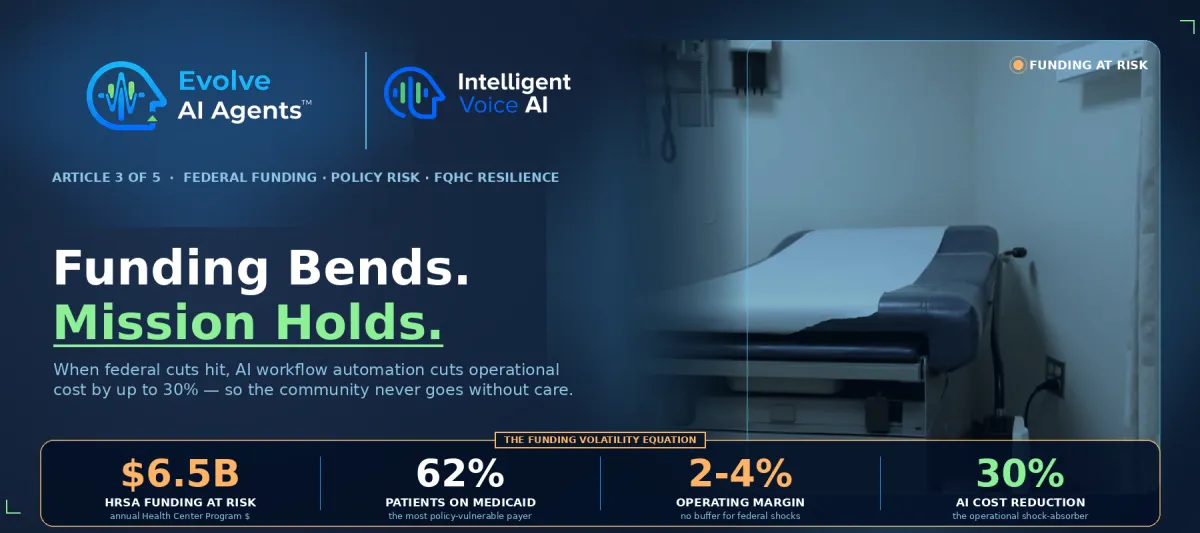
Annual HRSA health center funding at risk from federal budget cycles
62%
Of FQHC patients are covered by Medicaid or CHIP - the payer most vulnerable to policy change
30%
Average operational cost reduction potential with full AI workflow integration
Shannon Diem
Founder & CEO, Intelligent Voice AI (IVAI)
Evolve AI Agents · GetIVAI.com
Dr. Charles Howsare, MD, MPH
Preventive Medicine Physician
Primary Care
Federal Funding | Policy Risk | FQHC & RHC
Every health center administrator knows what it feels like to build a budget around a number that might not exist by October. Federal funding for community health has never been certain. But the combination of Medicaid restructuring proposals, Section 330 appropriations pressure, and shifting political priorities has pushed that uncertainty to a level that is forcing operational decisions that have real consequences for real patients. The clinics that survive funding volatility are the ones that have built operational efficiency deep enough to absorb the shock.
I started Intelligent Voice AI because I believe technology should serve the mission, not consume it. And when I look at what community health centers and rural health clinics are facing right now - federal budget battles, Medicaid block grant proposals, 340B program challenges, rising operational costs with flat or declining reimbursement - what I see is a sector that has been asked to do more with less for so long that it has normalized a level of financial fragility that would not be acceptable in any other part of healthcare. The difference is that in other parts of healthcare, when finances get tight, boards cut programs that aren't profitable. In an FQHC or a Rural Health Clinic, cutting programs means the people those programs served have nowhere to go.
That changes what operational efficiency means. It isn't about profit margin. It is about mission durability. Every dollar recovered through better billing, every staff hour redirected from administrative rework to patient care, every no-show prevented and PPS encounter captured - those are not financial metrics in isolation. They are the incremental resources that keep a health center's doors open when the federal budget process delivers bad news.
"The patients I worry about most are the ones who only have one option. In preventive medicine, continuity of care is everything - the relationship between a patient and a primary care provider over years is what catches the hypertension before it becomes a stroke, the A1c before it becomes dialysis. When a health center loses funding and closes a site, or eliminates a service line, or loses a provider because they can't sustain the salary, those patients don't find another provider. They disappear from the system. They show up later in emergency rooms with conditions we had years to prevent. That is the real cost of funding instability. It doesn't show up on a balance sheet. It shows up in outcomes data years down the road."
Dr. Charles Howsare, MD, MPH
Preventive Medicine Physician - Primary Care
The Funding Environment Health Centers Are Actually Operating In
The numbers behind this are worth stating plainly. Health centers receive approximately $6.5 billion annually through the HRSA Health Center Program, funded through a combination of mandatory and discretionary appropriations. That funding has faced recurring pressure in federal budget cycles, and the mandatory funding stream - established through the Affordable Care Act - has been subject to legislative challenge and continuing resolution uncertainty in multiple budget cycles. Every time Congress operates on a continuing resolution rather than a passed budget, health centers absorb the planning uncertainty.
Medicaid is the larger vulnerability. Approximately 62 percent of FQHC patients are covered by Medicaid or CHIP, according to HRSA UDS data. Proposals to convert Medicaid to a block grant or per capita cap structure have appeared in multiple federal budget proposals in recent years. The arithmetic is straightforward: a fixed federal Medicaid contribution in an environment of rising enrollment and rising acuity means states would face pressure to cut eligibility, reduce benefits, or lower provider rates - and FQHCs, as the providers of last resort for Medicaid beneficiaries, would absorb the impact directly.
Rural Health Clinics carry an additional layer of vulnerability. The RHC designation provides cost-based reimbursement from Medicare and Medicaid, but RHC certification requirements - staffing minimums, geographic eligibility, visit volume thresholds - create compliance overhead that small rural practices struggle to sustain. When a sole RHC provider retires, or when staffing falls below minimum requirements, the clinic can lose its RHC designation and its cost-based reimbursement status simultaneously. The financial cliff is immediate and steep.
THE CHALLENGE
Federal funding instability forces health centers into reactive budget management - holding positions vacant as a hedge against appropriations shortfalls, delaying capital investments, and maintaining cash reserves that should be deployed for patient services. Administrative overhead compounds the problem. Every staff hour spent on manual scheduling, claim rework, and phone-based outreach is a cost that shrinks the operating margin further. In an environment where every dollar matters, operational inefficiency is not just wasteful. It is a threat to the organization's ability to absorb the next funding disruption.
WHAT CHANGES
AI workflow automation reduces operational cost while maintaining service capacity. When routine tasks - appointment reminders, after-hours call handling, patient outreach, sliding fee intake, claims pre-submission review - are handled by AI agents, the cost per interaction drops substantially. That cost reduction builds the operational buffer that allows health centers to absorb funding shocks without immediately cutting services or staff. Implementation data shows overall operational cost reductions of 26 to 30 percent when AI automation is integrated across scheduling, outreach, and administrative workflows.
The 340B Challenge: Protecting a Critical Revenue Stream
The 340B drug pricing program is one of the most significant supplemental revenue sources available to eligible health centers and rural clinics. By allowing covered entities to purchase outpatient drugs at significantly reduced prices, 340B generates revenue that health centers can reinvest in services for low-income patients. For many health centers, 340B revenue represents five to fifteen percent of total operating revenue - in some cases more.
The program is under sustained legal and administrative pressure. Pharmaceutical manufacturer restrictions on contract pharmacy arrangements, ongoing litigation over program eligibility and audit rights, and recurring federal proposals to narrow program eligibility have created a compliance and administrative environment that requires active management. Health centers that are not actively monitoring their 340B program integrity, managing manufacturer restrictions, and optimizing their covered outpatient drug documentation are at risk of revenue loss that compounds the federal funding pressure they are already absorbing.
THE CHALLENGE
340B program integrity requires accurate patient eligibility documentation at every encounter - the patient must be a patient of the health center, the prescription must be written by a health center provider, and the encounter must be documented in the health center's system of record. When patient registration lapses, visit documentation is incomplete, or care coordination handoffs between providers aren't tracked accurately, 340B eligibility documentation gaps accumulate. In an audit environment, those gaps translate directly to repayment obligations and program integrity risks.
WHAT CHANGES
AI-assisted patient outreach and visit documentation workflows improve the completeness and accuracy of the patient encounter record that 340B eligibility depends on. When patients are consistently engaged before their visits, registration information is current, care coordination is documented in the EHR, and the audit trail supporting 340B eligibility is cleaner and more defensible. This is not a billing optimization. It is a compliance protection for one of the most valuable program revenue streams available to safety-net providers.
What the Data Shows About Financial Resilience and AI
REFERENCED DATA - AI INTEGRATION AND FQHC FINANCIAL RESILIENCE
26-30%
Reduction in operational costs with full AI workflow integration across scheduling, outreach, and administrative functions
McKinsey Global Institute - AI in Healthcare
$6.5B
Annual HRSA Health Center Program funding - subject to annual congressional appropriations and continuing resolution risk
HRSA Health Center Program - FY2024
62%
FQHC patients covered by Medicaid or CHIP - the payer source most exposed to federal and state policy changes
HRSA Uniform Data System (UDS) 2023
Here is the operational reality of a 26 to 30 percent cost reduction for a health center running on a two to four percent margin. It is not incremental improvement. It is a structural shift in the organization's ability to weather external shocks. A health center that reduces its administrative cost burden by 28 percent through AI integration has built a buffer that can absorb a 15 percent funding reduction without cutting a single service. That is the difference between a temporary disruption and a permanent loss of capacity.
The political environment is not going to become more predictable. Federal health policy has been contested terrain for over a decade, and the current environment offers little reason to expect stability. What health centers can control is their operational efficiency - their cost per encounter, their revenue capture rate, their staff retention, and the financial resilience that determines whether a funding cut means a difficult quarter or a permanent reduction in what the community receives.
"When I talk to health center leadership about AI integration, the conversation usually starts with efficiency and ends with survival. Not survival in a dramatic sense - but the practical reality that every dollar you spend on administrative overhead is a dollar you can't spend on the mission, and every dollar you recover through better operations is a dollar that keeps you standing when the funding environment gets worse. And right now, for most FQHCs and rural health clinics, the question isn't whether the funding environment will get worse. It's whether they'll be operationally positioned to absorb it when it does."
Shannon Diem
Founder & CEO - Intelligent Voice AI / Evolve AI Agents
Building the Operational Buffer Before the Next Cut Arrives
The organizations that will come through the next round of federal funding pressure intact are not necessarily the ones with the strongest political advocacy or the largest grant portfolios. They are the ones that have done the operational work to reduce their cost base, improve their revenue capture, and build enough margin into their operations to absorb a shock without immediately translating it into a service cut.
AI integration across scheduling, patient outreach, revenue cycle, and care coordination is not a technology project. It is a financial resilience strategy. The health centers and rural clinics that treat it as such - that measure AI implementation against operational cost reduction, revenue recovery, and service sustainability rather than technology adoption metrics - are the ones that will still be serving their communities five years from now, regardless of what happens in Washington.
The mission is fixed. The funding is not. Build accordingly.
Federal funding will keep changing. The communities you serve can't afford to wait for it to stabilize.
Learn how Evolve AI Agents can build financial resilience into your health center operations.
HIPAA-compliant, EHR-integrated AI tools for scheduling, outreach, billing, and care coordination - built for the funding volatility of community health.




Products
Solutions
Resource
Company
© 2026 Intelligent Voice AI™