Intelligent Voice AI


SERVICE OPERATIONS - E&O EXPOSURE - AGENCY RESILIENCE
The Endorsement Backlog Is Where Retention and E&O Claims Are Made.
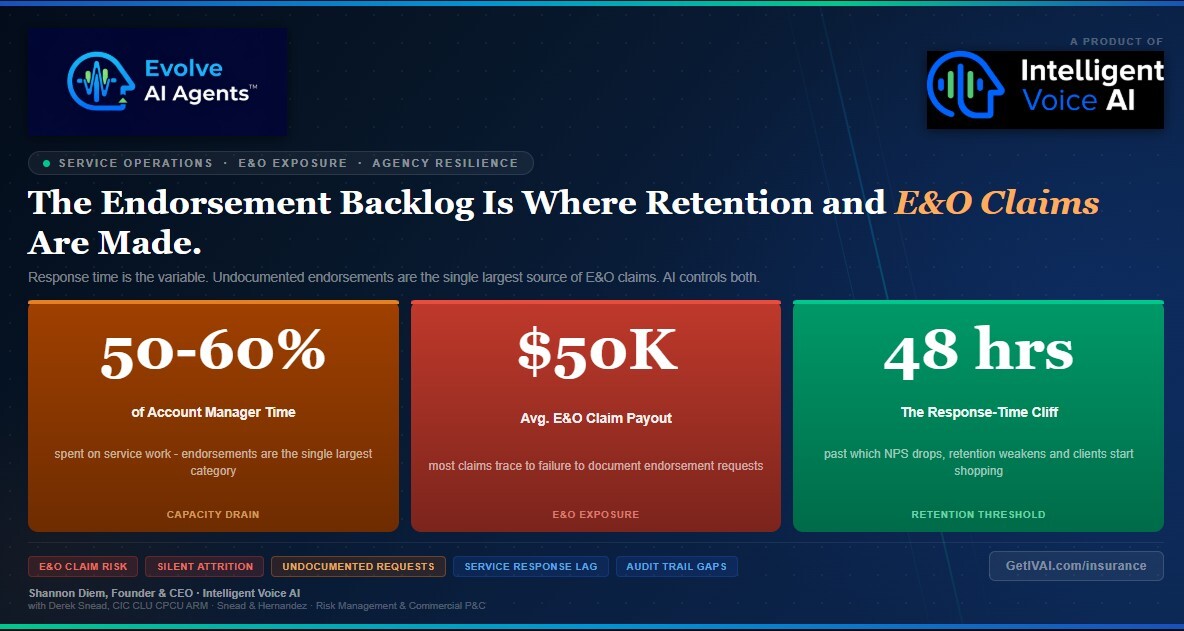
Mid-term endorsement requests are the background radiation of every independent agency - and the single largest source of E&O claims, service failures, and silent client attrition. Response time is the variable. AI is what controls it.
The endorsement is where the agency keeps its promise to the client mid-policy. Add the vehicle. Change the driver. Update the lienholder. Increase the liability limit on the warehouse. Add the new entity to the named insured. Report the property sale. The requests arrive constantly, from every channel, and the service team handles them against a backdrop of every other commitment the agency has on any given day. Independent Insurance Agents & Brokers of America research consistently places service work at 50 to 60 percent of account manager time - with mid-term endorsements the single largest category by volume.
The operational pain is chronic. The financial consequence is episodic and severe. Service response times past a 48-hour threshold measurably degrade retention. Undocumented or missed endorsements are the single largest source of E&O claims in property-and-casualty insurance. The agencies that manage through both variables are the ones that systematize the endorsement workflow. The ones that don't absorb both costs - slowly, invisibly, until the renewals stop renewing or the E&O claim arrives.
50-60%
Of account manager time is spent on service work at a typical independent agency, with mid-term endorsements the largest individual category
$50K
Average E&O claim payout in P&C (range $30K-$50K) - with most claims tracing to failure-to-procure or failure-to-document endorsement-related service events
48 hrs
The documented response-time threshold past which NPS drops, retention weakens, and clients begin shopping the relationship
Shannon Diem
Founder & CEO, Intelligent Voice AI (IVAI)
Evolve AI Agents · GetIVAI.com
Derek Snead, CIC, CLU, CPCU, ARM
Snead & Hernandez
Risk Management & Commercial P&C
Service Operations | E&O Exposure | Agency Resilience
Every agency owner knows the E&O claim that starts with "the client called on Tuesday to add the vehicle and nobody ever submitted it to the carrier." It is the story most often told - and the operational failure most common across every size of agency, every line of business, and every AMS. The problem is not that CSRs don't know how to process endorsements. It is that the volume, velocity, and documentation burden of endorsement work has outpaced what any manual workflow can consistently deliver.
Mid-Term Service Requests: The Background Radiation of an Agency
The volume is what makes the endorsement workflow different from every other service category. An account manager at a $5 million mixed P&C agency typically fields 30 to 60 mid-term service requests per week across a book of 150 to 250 accounts. Most of those requests do not show up in any pipeline report. They are handled in the background - by email, by phone, by AMS task - and the only visibility into them is whatever documentation the account manager chose to enter at the time. When volume spikes or a team member is out, the gaps open quickly. And because the failure mode is drift rather than breakage, nobody notices until the account doesn't renew or the claim arrives.
The invisibility is the operational hazard. An agency that cannot count the endorsement requests it received in the last 30 days, or measure the average response time against its service standard, or audit whether every requested endorsement was actually submitted to the carrier, does not know how its service function is performing. It is operating on reputation and memory. In a book of 1,500 service events a quarter, that is not enough.
The 48-Hour Response Cliff and What It Does to Retention
Industry retention analytics across mid-size independent agencies consistently identify a response-time threshold around 48 hours past which client satisfaction scores inflect downward. Inside that window, clients experience the agency as responsive. Beyond it, they experience the agency as slow - and slow agencies lose accounts at renewal, even when the coverage and pricing are correct. A service lag of one or two days past the threshold does not cause a client to leave in the moment. It causes a client to entertain the next phone call from a competing agent six months later in a way they would not have entertained otherwise.
The math on that threshold is unforgiving. A 1.5-percentage-point erosion in retention on a $5 million book is roughly $75,000 in recurring commission revenue annually - compounding year over year. An agency that consistently performs inside the 24-hour response window is systematically retaining business that agencies at 72 hours are systematically losing. The difference between those two outcomes is rarely effort. It is workflow.
E&O Exposure: The Cost of an Undocumented Endorsement
Every major independent-agency E&O carrier publishes the same claim pattern in its loss-prevention guidance: the highest-frequency claim in property-and-casualty insurance is a client request for a coverage change that was not completed, not documented, or not confirmed. The client calls. The account manager takes the request. The handoff to the carrier fails - sometimes through simple oversight, sometimes through a staff departure, sometimes through a handoff between two team members where each assumed the other closed the loop. Six months later a loss occurs, the client believes the coverage was in place, and the agency's defense rises or falls on what the file actually contains.
Average E&O payouts in P&C run $30,000 to $50,000 per claim, with severity reaching six figures on commercial accounts. Most agencies carry E&O deductibles of $25,000 to $50,000 - which means a single endorsement-related claim is a real P&L event regardless of the carrier payout. The defense, in nearly every case, depends on the agency's ability to produce a timestamped, channel-captured, confirmed-by-the-carrier audit trail of the request. Agencies with that documentation win. Agencies without it settle.
What AI-Integrated Endorsement Workflows Produce
The workflow is not complicated. It is a sequence of consistent touchpoints - captured, timestamped, documented - that execute the endorsement end-to-end. A client calls, texts, or emails the endorsement request. The AI agent captures the request with full transcript or original communication attached, validates the effective date and any required signatures, prepares the carrier submission, sends the client a confirmation with timestamp, schedules the carrier-confirmation follow-up, and logs every step in the AMS with an immutable audit trail. The account manager sees only the exceptions - the requests that require judgment, underwriting confirmation, or coverage review.
The operational impact is a standard response time measured in minutes rather than hours, and a 100-percent capture rate on the documentation that E&O defense depends on. The financial impact compounds through three channels: capacity reclaimed on the service team (approximately $84,000 of loaded account-manager time at a $5 million agency), retention lift worth approximately $75,000 in recurring revenue as response-time performance crosses the industry threshold, and reduced E&O expected value of roughly $27,000 annually as claim frequency drops. Most independent-agency E&O carriers additionally offer 5 to 10 percent premium credit for documented audit-trail systems, which typically pays for the technology on its own.
"The pattern I have watched across 25 years in the business is that the agencies with the worst E&O records don't have the worst CSRs. They have the busiest ones. Claims trace back to endorsements the team knew about, agreed to handle, and then lost in the volume - because nothing in the workflow was designed to catch the drop. Every agency I have audited that brought in AI-driven service workflows saw the audit trail improve within a quarter. That audit trail is the defense in half the claims I see. It is not just an efficiency win. It is an insurability win."
Derek Snead, CIC, CLU, CPCU, ARM
Snead & Hernandez
Risk Management & Commercial P&C
THE CHALLENGE
Endorsement volume is constant, invisible, and poorly measured. An account manager typically fields 30 to 60 mid-term service requests a week - adds, changes, certificates, documentation updates, coverage adjustments - across a book of 150 to 250 accounts. Most never show up in a pipeline report. Most are handled in the background. When response times slow past a 48-hour window, retention measurably erodes - and the agency doesn't see it until the account doesn't renew. The failure mode is drift, not breakage.
WHAT CHANGES
AI-integrated endorsement workflows intake requests through any channel, validate effective dates and required documentation, prepare the carrier submission, send client confirmation with timestamps, schedule the carrier-confirmation follow-up, and log every step with a complete audit trail in the AMS. Response times collapse from days to minutes on standard requests. The account manager sees only exceptions and stays focused on the service work that actually requires judgment.
THE CHALLENGE
E&O exposure on endorsement-related work concentrates in the gap between "the client requested it" and "the documentation proves we handled it correctly." The most common E&O fact pattern in P&C is a phone call from the client requesting a coverage change, an internal handoff that nobody closes, and a claim six months later for a loss the client believed was covered. Every agency has the risk. Most agencies don't have the audit trail.
WHAT CHANGES
Every endorsement request handled by an AI-integrated workflow is captured end-to-end - the original intake (voice, text, email, web), the policy verification, the carrier submission, the client confirmation, the follow-up confirmation from the carrier - with timestamps, with call recordings where applicable, and with an immutable log. That documentation is what wins the E&O defense. It is also what E&O carriers reward with better rates.
REFERENCED DATA - SERVICE OPERATIONS, E&O EXPOSURE, AND AI-INTEGRATED WORKFLOWS
"I don't think owners appreciate how much of the agency's financial destiny rides on how the service team handles endorsements. It's quiet. It's unglamorous. It doesn't show up in a sales dashboard. But the retention delta between an agency that responds to service requests in two hours versus two days is the difference between 91 and 87 percent retention - and four points on a book that size is six figures in recurring revenue. AI is the only technology I have seen that actually closes that response-time gap without forcing the agency to hire into it."
Shannon Diem
Founder & CEO, Intelligent Voice AI - Evolve AI Agents
The endorsement is the moment the agency proves itself to the client - and the moment it proves itself to its own E&O carrier. What separates agencies that grow through renewal cycles from agencies that bleed out of them is not how hard the service team works. It is how reliably the service workflow captures every request, every confirmation, every document, every time.
See how Evolve AI Agents handle mid-term endorsement workflows and E&O-grade documentation at agency scale.
Voice, text, email, and web intake. AMS-integrated. Audit-trail ready. Built for independent agencies where service response time is the retention lever and the E&O defense.




Products
Solutions
Resource
Company
© 2026 Intelligent Voice AI™