Intelligent Voice AI


CARRIER ACCOUNTING - COMMISSION INTEGRITY - EBITDA RECOVERY
The 5% You Can't See: How Commission Leakage Is Costing Agencies Six Figures a Year.
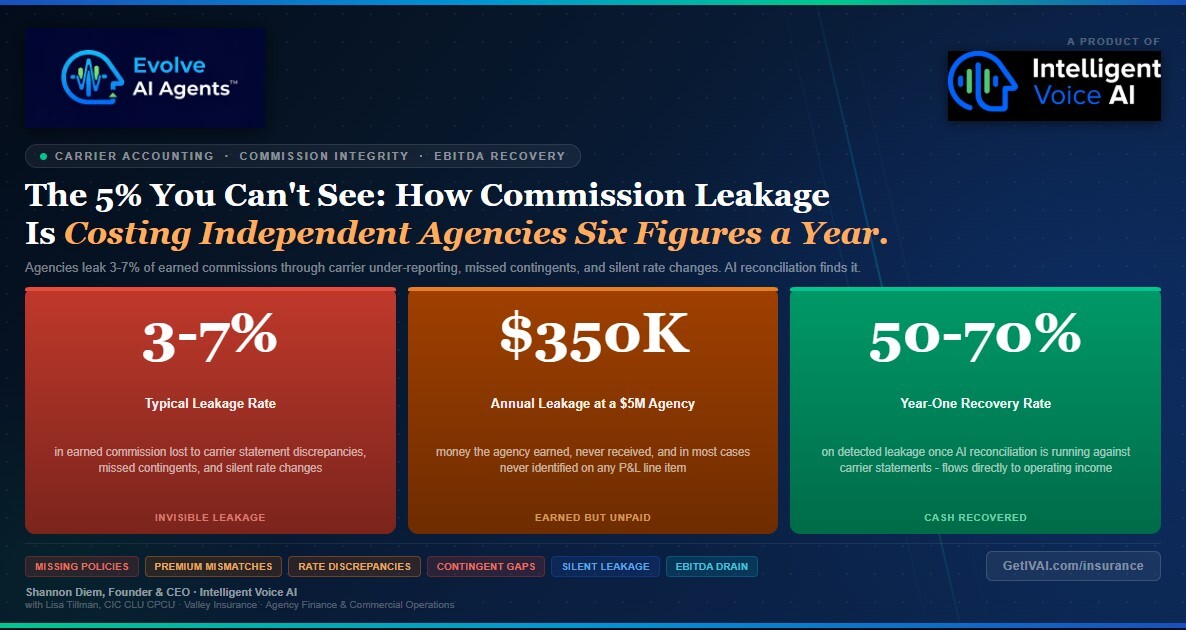
Independent agencies routinely leak 3 to 7 percent of earned commissions through carrier under-reporting, missed contingents, and silent rate changes. On a $5 million agency that is $150,000 to $350,000 a year - invisible until somebody measures it. Here is what the leakage looks like and what AI-integrated reconciliation recovers.
Commission reconciliation is the least-visible function in an independent agency. It is also, at most agencies, the largest single recoverable line item on the P&L. The gap between those two statements is what makes the topic so uncomfortable. The leakage doesn't announce itself. No carrier sends an invoice for the commissions it failed to remit. The agency receives a statement, the accounting team reconciles what it can, the remainder ships to general ledger, and the cycle repeats. Three to seven percent of earned commission walks out the door every year - silently, predictably, and without a line item anywhere in the agency's reporting that names it.
The math is meaningful. A $5 million agency leaking at the midpoint of the industry range loses roughly $250,000 a year in earned but unreceived commission. For an agency operating at industry-standard margins of 15 to 20 percent, that is the equivalent of $1.25 million to $1.7 million in revenue the agency would have to produce to generate the same operating income. No acquisition, no cross-sell campaign, no renewal retention initiative offers an ROI in that range. The leakage is sitting inside the existing book. The question is whether the agency has the operational infrastructure to find it.
3-7%
Typical commission leakage rate at independent agencies across carrier statement discrepancies, missed contingents, and silent rate changes
$350K
Annual commission leakage at a $5M revenue independent agency (range $150K-$350K) - money the agency earned but never received
50-70%
Realistic year-one recovery rate on detected leakage once AI-integrated reconciliation is operating against carrier statements
Shannon Diem
Founder & CEO, Intelligent Voice AI (IVAI)
Evolve AI Agents · GetIVAI.com
Lisa Tillman, CIC, CLU, CPCU
Valley Insurance
Agency Finance & Commercial Operations
Carrier Accounting | Commission Integrity | EBITDA Recovery
Every independent agency in the country has a number on its P&L that is smaller than it should be. It is the commission income line. The amount by which it is smaller varies by carrier mix, book composition, and how many statements the accounting team actually reconciles in detail. Industry analyses put the leakage at 3 to 7 percent of earned commission - money the agency earned, never received, and in most cases never identified.
The Carrier Statement Problem Nobody Actually Owns
Carrier statements arrive in a dozen formats. PDF exports with policy-level detail. CSV files with aggregate totals. EDI feeds from the national carriers. Portal-only reports from the regionals that require manual download. Some arrive monthly. Some arrive quarterly. Some arrive with commission override agreements embedded in separate amendment documents that the accounting team has never seen. The reconciliation process, across that ecosystem, is structurally impossible to execute manually at the line-level detail the job actually requires. So it doesn't get executed that way. It gets sampled.
The sampling approach works well enough most of the time. The aggregate totals line up with the agency's production report within a reasonable tolerance. The statement is reconciled in the broad sense. What gets lost is the policy-level discrepancies - a missing policy here, a wrong premium there, a rate that silently changed from 15 percent to 14 percent three statements ago. Each one is small. All of them together constitute the 3 to 7 percent leakage the industry consistently documents.
Where the Leakage Actually Lives
Four categories account for most of the leakage on a typical agency's statements. The first is missing policies - accounts that exist in the AMS, are paying premium to the carrier, and for whatever reason were not included on a given month's commission statement. The second is premium mismatches - the carrier reporting a different premium amount than the agency expected, often driven by a mid-term endorsement that was not properly flowed through to the commission calculation. The third is commission rate mismatches - the agency's contract specifies 15 percent, the statement reflects 14.25 percent, and nobody catches the adjustment until multiple cycles later, if at all. The fourth is unapplied endorsement activity - premium increases from endorsements processed during the statement period but not reflected in the commission base.
Any one of those four categories, operating silently over 12 monthly statement cycles across 10 to 15 carriers, generates the kind of aggregate leakage that shows up nowhere in the P&L and everywhere in the agency's unearned income. The reason the leakage persists is not that it is hard to detect in principle. It is that nobody has the operational bandwidth to detect it in practice.
The Contingent Bonus Trap
The most acute leakage at most agencies is not on regular commissions. It is on contingent and profit-sharing bonuses. These structures - tier-based bonuses with loss-ratio qualifiers, volume-to-threshold requirements, mid-year amendment adjustments, growth qualifiers tied to prior-year production - are documented in carrier contracts the agency signed at some point in the past and has rarely reviewed since. The qualifiers change. The tiers shift. The mid-year amendments arrive in letters nobody tracks against the contract. And at year-end, the carrier calculates the bonus based on the current rules, and the agency receives whatever number the carrier produces.
The leakage pattern here is particularly costly because the sums are large and the qualifiers are knowable in advance. An agency within five points of a higher tier in November has a meaningful production decision to make in December - if anyone at the agency knows the agency is within five points. In most agencies, nobody does. The year closes, the carrier lands the agency in whatever tier the actual production produced, and a qualifying bonus of $40,000, $75,000, or $150,000 gets left on the table because the agency didn't track the progress against the threshold in real time.
What AI-Integrated Commission Reconciliation Recovers
The operational shift is the move from sample-based monthly reconciliation to line-by-line continuous reconciliation. AI document-vision agents ingest carrier statements in any format - PDF, CSV, EDI, portal export - normalize the data into a common structure, and match every line against the agency's book in the AMS. Every discrepancy is flagged. Every missing policy is identified. Every premium mismatch is surfaced with the corresponding AMS record attached. Every rate mismatch is highlighted against the carrier contract. Instead of producing a sampled reconciliation, the system produces a dispute ledger - carrier by carrier, line by line, with the supporting evidence ready for submission.
The contingent and profit-sharing layer operates continuously rather than at year-end. The system tracks each carrier's contingent structure against the agency's live production data, monitors loss-ratio trajectory against threshold requirements, flags mid-year amendment changes against the contract of record, and projects year-end qualification status with enough lead time that the agency can make production decisions while there is still time to act. When a bonus is underpaid, the dispute is generated automatically with the contract reference and the production data attached.
Year-one recovery rates at agencies that deploy AI-integrated reconciliation against existing carrier statements consistently land in the 50 to 70 percent range on detected leakage - with the remainder driven by contract disputes, statute-of-limitations issues on older leakage, and carrier-side policy corrections that take multiple cycles to flow through. On a $5 million agency detecting $250,000 in leakage, that is $125,000 to $175,000 of cash recovered in the first year - with forward-prevention typically pushing year-two recovery higher as the agency begins catching contingent qualifiers in real time rather than after the fact. Every dollar recovered flows directly to operating income.
"I have been on both sides of this - running an agency and consulting with them - and I can tell you that commission reconciliation is the most under-resourced function in an independent agency. The accounting team isn't to blame. They're reconciling against twelve carriers each sending statements in a different format, some monthly, some quarterly, with contingent structures that change mid-year and half the time aren't documented in writing. Nobody has ever given them the tools to do the job properly. What AI reconciliation does is take the dozen statement formats, normalize them against the book of business, and surface the discrepancies. The first month an agency runs it, the recovery number is always larger than they expected."
Lisa Tillman, CIC, CLU, CPCU
Valley Insurance
Agency Finance & Commercial Operations
THE CHALLENGE
Carrier statements arrive in a dozen formats - PDF, CSV, EDI, portal-only, some with policy-level detail, some with aggregate totals. Reconciliation against the agency's book of business is a line-by-line process. In practice, it is a sample-and-ship process. The accounting team spot-checks, flags what it can see, and closes the month. Missing policies, under-paid commissions, wrong premiums, and incorrectly calculated base rates all flow through. Month over month the leakage accumulates with nobody identifying it.
WHAT CHANGES
AI-driven document-vision agents ingest carrier statements in any format, normalize the data, match it line-by-line against the AMS book, and flag every discrepancy - missing policies, premium mismatches, commission rate mismatches, unapplied endorsement activity. The accounting team receives a pre-built dispute ledger with the supporting evidence attached rather than a blank spreadsheet. The reconciliation process shifts from sampling to full coverage.
THE CHALLENGE
Contingent and profit-sharing bonuses are where the largest leakage concentrates and where the smallest number of agencies actually reconcile. Tier-based bonuses with loss-ratio qualifiers, volume-to-threshold requirements, and mid-year amendment adjustments get missed because nobody is reading the carrier amendments at line 47. Bonuses earned sometimes never get booked. Bonuses qualified-for sometimes never get received. For an agency with meaningful contingent exposure, the leakage on bonuses alone can run into six figures.
WHAT CHANGES
AI agents track the contingent qualifiers continuously - not at year-end. Loss-ratio trajectory, volume-to-threshold progress, mid-year amendments, qualifier changes are all monitored against each carrier contract. When the agency is within striking distance of a higher tier, the system flags it for the owner and the production team in time to take action. When the carrier underpays a booked bonus, the dispute is generated automatically with the contract reference and the production data attached.
REFERENCED DATA - CARRIER ACCOUNTING, COMMISSION LEAKAGE, AND AI-INTEGRATED RECONCILIATION
"The reason this topic gets so little airtime in agency circles is that the leakage is silent. Nobody sends you an invoice for the commissions you didn't receive. If you're not reconciling to the line level, you don't know what's missing - and if you don't know what's missing, you don't know what the AI is going to recover until it starts running. What I tell agency owners is that the first statement cycle with reconciliation turned on is going to surprise you. It always does. The only question is whether it's a small surprise or a life-changing one."
Shannon Diem
Founder & CEO, Intelligent Voice AI - Evolve AI Agents
The commission income line is the purest reflection of everything the agency did right - the business it wrote, the policies it renewed, the bonuses it qualified for. When it is under-reported, the agency's financial picture is literally wrong. Getting that line correct is not a technology problem. It has been a data problem for thirty years. It is now a solvable one.
See how Evolve AI Agents reconcile carrier commission statements, track contingent qualifiers, and recover leakage for independent agencies.
Any statement format. AMS-integrated. Dispute-ledger ready. Built for agency owners who want their commission income line to actually reflect what they earned.




Products
Solutions
Resource
Company
© 2026 Intelligent Voice AI™