Intelligent Voice AI


COMMERCIAL OPERATIONS - CSR CAPACITY - UNBILLABLE WORKLOAD
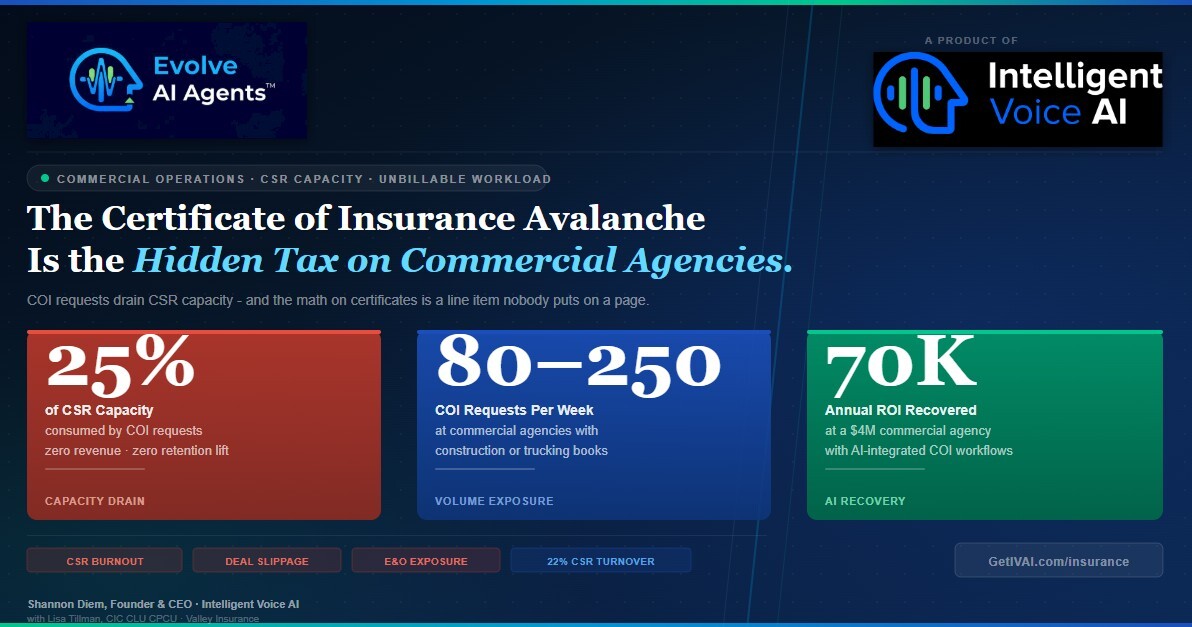
The Certificate of Insurance Avalanche Is the Hidden Tax on Commercial Agencies.
COI requests can consume up to a third of commercial CSR capacity - time that generates zero new revenue and zero retention lift. For commercial agencies with construction, trucking, or contractor-driven books, the math on certificates is a multi-hundred-thousand-dollar line item nobody puts on a page. Here is what AI-integrated certificate management actually recovers.
Every commercial agency owner has the same unspoken understanding of the certificate of insurance workflow: it is the thing the service team does between the things that actually generate revenue. It is tolerated. It is not measured. And the longer it goes unmeasured, the more capacity it quietly consumes. Industry analyses place certificate handling at roughly a quarter of commercial CSR capacity across independent agencies - and significantly higher at agencies with construction, trucking, and real-estate-heavy books. That is not a rounding error. At a $4 million commercial agency with six service staff, one quarter of capacity is a full CSR equivalent - more than $100,000 a year in loaded labor cost spent generating zero new revenue and zero retention lift.
The difficulty is that the certificate is necessary. Contractors can't bid jobs without one. Tenants can't sign leases without one. Fleet operators can't move a truck without one. The agency has to deliver, and deliver fast. The question is not whether to do the work. The question is whether a CSR has to do it.
25%
Of commercial CSR capacity consumed by COI requests at typical commercial agencies - time that generates zero new revenue and zero retention lift
80-250
COI requests processed per week at a commercial agency with a construction or trucking book concentration - every week, without exception
$170K
Conservative annual operational ROI at a $4M commercial agency (range $135K-$170K) when AI-integrated workflows take over standard certificate handling
Shannon Diem
Founder & CEO, Intelligent Voice AI (IVAI)
Evolve AI Agents · GetIVAI.com
Lisa Tillman, CIC, CLU, CPCU
Valley Insurance
Commercial Lines & Agency Operations
Commercial Operations | CSR Capacity | Unbillable Workload
The certificate of insurance is a one-page document. In most commercial agencies it is also the single largest drain on service staff time, the most common reason for deal slippage at the contractor level, and the purest example of an operational workflow that technology has been capable of solving for a decade - and somehow hasn't.
The Math of COI Workload in a Commercial Agency
The volume is the part most agency owners have never actually counted. A commercial agency with 400 active commercial accounts and a moderate contractor concentration will typically process 80 to 150 COI requests in a normal week. An agency with heavy construction or trucking exposure routinely exceeds 200 a week - and during peak bid seasons, 250 or more. Each standard request, processed manually, runs 8 to 15 minutes: pull the policy, confirm the holder language, add the additional insured, format the certificate, send, file, and log. Non-standard requests - ones requiring a waiver of subrogation, a specific primary/non-contributory wording, or a carrier-specific endorsement - push into 30 to 60 minutes each.
Multiply those minutes by the annual volume. A commercial agency at 150 COI requests per week is processing roughly 7,500 certificates a year. At 12 minutes of average handling time, that is 1,500 hours of CSR capacity consumed annually - the equivalent of a dedicated full-time position whose entire job is certificate production. Most agencies don't have a dedicated COI producer. The work gets absorbed across the service team, which is how 25 percent of commercial CSR capacity ends up booked against a workflow that historically never shows up on any operations dashboard.
Why COIs Are the Most Expensive Cheap Task in the Office
The paradox of the certificate of insurance is that it looks like the least important thing on the service team's desk and functions as one of the most important. A slow COI is a deal-killer. A contractor who can't get a certificate within an hour to confirm a bid will call another agency. A tenant whose lease is held up by a pending certificate will remember the friction. A fleet manager who has to send three follow-up emails to get a standard certificate out will begin the process of finding a different agency partner. The agency doesn't see the attrition - the account simply doesn't renew, or the new account never materializes, and the COI workflow gets blamed for nothing because nobody ever connected the dots.
The internal cost is real and measurable. The external cost is real and invisible. Together they represent one of the largest silent profit drags in commercial agency operations - and the one most amenable to being fixed.
The Operational Case for AI-Integrated Certificate Management
The work of generating a standard certificate of insurance is a closed-loop task with unambiguous inputs. The requester is identified. The underlying policy exists in the AMS. The additional-insured language is either on file or specified by the requester against a known template. The format is standardized. The delivery channel is established. Every step is a rule-driven workflow. None of it requires a licensed insurance professional to perform - and yet, across most independent agencies, a licensed insurance professional is exactly who is performing it.
AI-integrated certificate management inverts the ratio. The voice, text, email, and web-intake agent takes the request in, authenticates the requester, pulls the underlying policy, applies the correct additional-insured and holder language, generates the certificate, delivers it to the requester, logs the action, and files it in the AMS - typically in under 90 seconds, 24 hours a day. Only the exception requests - the non-standard endorsements, the carrier-specific wording that requires underwriting confirmation, the unusual coverage questions - get escalated to a CSR. And those escalations arrive with the policy already pulled, the historical correspondence already attached, and any prior similar requests already linked. The CSR starts with 80 percent of the preparatory work already done, not zero.
What Automated COI Handling Actually Looks Like
The operational result is measurable within a single monthly cycle. Standard certificate turnaround collapses from hours or days to under two minutes. CSR hours redeploy from certificate production to account development, renewal work, cross-sell outreach, and new business quoting - the work the commercial agency actually needs its CSRs doing. Client satisfaction scores on certificate delivery - a metric most agencies don't track but should - improve materially, because the friction that used to define the relationship simply goes away. Contractors bid faster. Tenants sign faster. Fleet operators move faster. And the agency demonstrates, with every certificate, that it is the operational partner its clients need it to be.
The financial result is equally measurable. A $4 million commercial agency with six CSRs that reclaims 25 percent of its CSR capacity recovers roughly $102,000 per year in loaded labor. Add the 5 to 10 commercial accounts annually that no longer slip to a competitor over a slow certificate, at roughly $1,800 per account in first-year commission, and another $9,000 to $18,000 enters the picture. Add the reduction in CSR turnover - commercial service staff consistently cite COI workload as a leading source of burnout, and at 22 percent industry turnover a single avoided replacement is roughly $25,000 - and the annual operational ROI lands in the $135,000 to $170,000 range on a conservative model. Evolve AI Agents typically represent less than 10 percent of that recovery as a subscription cost, with the remainder flowing directly through to the agency's operating income.
"Every agency owner I talk to has the same blind spot on COIs. They know the team is drowning - they can feel it in the turnover, the service complaints, the email chains that run 14 deep to get a standard certificate out the door. What they don't see is the dollar figure attached to it. When you actually run the math on the CSR hours a commercial agency burns on certificates in a year, it's a multi-hundred-thousand-dollar line item on a spreadsheet that nobody ever builds. The agencies that grow through a hard market are the ones that put that math on a page and decide they aren't going to pay it anymore."
Lisa Tillman, CIC, CLU, CPCU
Valley Insurance
Commercial Lines & Agency Operations
THE CHALLENGE
Standard COI request volume overwhelms CSR capacity at every commercial agency with meaningful construction, trucking, or real-estate exposure. A single active contractor account may generate 15 to 25 certificates a year. A contractor book of 150 accounts can produce 3,000 to 5,000 COI requests annually. Each standard request - pull the policy, confirm additional-insured language, format, send, file - runs 8 to 15 minutes when everything is routine. The service team absorbs the volume by compressing everything else, including the revenue-generating work the book needs for growth.
WHAT CHANGES
AI-integrated certificate workflows take the COI request in by voice, text, email, or web, authenticate the requester, pull the underlying policy from the AMS, verify the holder and additional-insured language, generate the certificate, deliver it to the requester, and log the action - typically in under 90 seconds, around the clock. The CSR only gets involved when something is actually exceptional. In practice this reclaims roughly 25 percent of CSR capacity back to the team - capacity that historically went to manual certificate work and now gets redeployed to new business, cross-sell, and account development.
THE CHALLENGE
Non-standard COI requests - the ones requiring an actual endorsement, a waiver of subrogation, a specific primary/non-contributory wording, or a carrier-specific form - are where both time and risk concentrate. These are the requests that sit in a queue for 24, 48, 72 hours because the CSR needs to get the carrier on the phone and the carrier is on hold. They are also the ones where a missed word or incorrect endorsement reference becomes an E&O exposure. The pressure to close the loop fast routinely collides with the pressure to close it correctly.
WHAT CHANGES
AI agents route non-standard requests to the correct CSR pre-staged - the policy is already pulled, the historical correspondence is attached, any prior similar requests from the same holder are linked, and a draft endorsement submission is ready for review. The CSR starts with 80 percent of the preparatory work done rather than zero. That collapses handoff time from hours to minutes and builds an automatic audit trail of every request, review, and submission - which is exactly the documentation E&O carriers credit when they price the agency's program.
REFERENCED DATA - COI VOLUME, CSR CAPACITY, AND AI-INTEGRATED CERTIFICATE MANAGEMENT
"The thing I try to get agency owners to understand about COIs is that you can't grow through them manually. You can absorb them for a while. You can crunch harder, hire another CSR, stretch the team. But in a commercial agency with a real construction book, the COI workload compounds faster than CSR capacity can grow - because every new account brings its own certificate pipeline. AI isn't optional here. It is the only path to growing the book without linearly growing the service payroll, and it is the only path to retaining CSRs who are being asked to do the work."
Shannon Diem
Founder & CEO, Intelligent Voice AI - Evolve AI Agents
The COI workload is not going away. It is going to grow - with every new commercial account, with every tightening of insurance requirements in construction and real estate contracts, with every month. What has changed is that the technology to take the standard work off the desk of the person who should be building the book finally exists, and the agencies deploying it are measurably pulling away from the ones that aren't.
See how Evolve AI Agents handle certificate of insurance workflows at full agency volume.
Voice, text, and email intake. AMS-integrated. Audit-trail ready. 24/7. Built for commercial agencies where the service workload is the growth constraint.




Products
Solutions
Resource
Company
© 2026 Intelligent Voice AI™